The pitch is irresistible: go to sleep, wake up, and a hundred applications have already gone out in your name. Auto-apply bots promise to delete the most soul-crushing part of the job hunt. So is it safe to hand them the keys?
The honest answer is that it depends entirely on how you use it. Using AI to draft, tailor, and speed up applications that you review and submit is safe and increasingly normal. Pointing a bot at the internet to mass-fire hundreds of generic applications a day is where you invite throttling, account restrictions, recruiter blacklisting, and a return so low it barely registers.
Here is the sourced, unhyped version of where the line is, drawn from recruiters, platform behavior, and one very revealing 819-application experiment. For how the underlying tech works, see our auto-apply technology explainer; this piece is about the risks.
First, the trap nobody mentions: the AI doom loop
The deepest risk of auto-apply is not your bot; it is that everyone has one. Greenhouse research found 67% of U.S. candidates now use AI in the job hunt, 22% use bots to submit applications, and 28% use AI to generate fake work samples. Employers respond by screening with AI, and LinkedIn alone now processes more than 11,000 applications a minute.
When applying becomes instant and free, volume explodes by design, and the signal that used to separate you from the pile collapses. As one industry analysis put it, quoting former recruiting executive Nolan Church, when every resume looks optimized, keyword matching becomes meaningless. The more aggressively you automate, the more you blend into exactly the flood recruiters are building filters to reject. That is why applying to fewer, better-fit roles keeps beating spraying 500 applications.
Hiring is stuck in an AI doom loop.
— Daniel Chait, CEO and co-founder of Greenhouse
Will auto-applying get you banned on LinkedIn?
Short answer: it can throttle or restrict you, and the trigger is speed more than volume. LinkedIn does not publish an official Easy Apply cap, but users consistently hit a soft limit around 50 submissions per rolling 24 hours, and Premium does not raise it. Hitting that soft cap usually carries no penalty; the counter just resets.
The real danger is velocity. Designer Trisha Pawar got her Easy Apply access frozen for 30 minutes, and she was not even running a bot. She was just fast, in a market where, she notes, 500 applications in a day is considered the bare minimum. A tool moving at machine speed trips those inauthentic-activity detectors far harder, and the worst outcomes, long or permanent restrictions, tend to show up when high-volume applying is combined with scraping profile data outside the normal apply flow. A safe daily pace sits well under the throttle line, spread across the day, with no harvesting.
LinkedIn blocked me because I was applying to Easy Apply jobs too fast, and I was using 'automated inauthentic activities.'
— Trisha Pawar, designer and writer
Can recruiters and ATS tell you used a bot?
Often, yes, and the tells are mundane. Sprad CEO Jürgen Ulbrich lists the patterns that get applications flagged as spam: dozens of very similar applications from one person within minutes, generic buzzword-heavy cover letters that never mention the actual role, and mismatched levels like a junior CV fired at director roles. One recruiter described receiving eight applications from the same candidate in two minutes, several for the same job, and the system flagged them as spam.
The detection signature is simple: duplicate answers, a generic resume reused across wildly different jobs, and machine velocity. You do not need fancy fraud tooling to catch it; a human reading two identical applications catches it instantly. This is the same dynamic that sends generic applications into spam filters and why tailored applications still beat automated blasts.
And recruiters? They can tell. You wouldn't send the same message to five different friends and expect them all to feel special, right?
— Rohit Bhat, Bloom
Safe vs. risky: what trips detection
Same tool, very different outcomes depending on how you point it. Here is the line between compliant and flagged.
| Behavior | Risk | What the system or recruiter sees | Compliant alternative |
|---|---|---|---|
| Bot auto-submits hundreds of apps a day at machine speed | High (bans / throttles) | Machine velocity flagged as automated inauthentic activities; LinkedIn locked one user for 30 minutes | Keep daily count well under ~50 Easy Apply, spread across the day at a human pace |
| Same generic resume blasted to every role | High (recruiter rejects) | Buzzword-heavy, never mentions the actual role; obvious to ATS filters and humans | Tailor each application to the specific job description |
| Duplicate answers, multiple apps to one job in minutes | High (spam flag) | Eight applications from the same candidate in two minutes, flagged as spam | One reviewed, distinct application per role |
| Junior CV fired at director-level postings | Medium-High (mismatch flag) | Mismatched seniority stands out as indiscriminate blasting | Apply only to roles you fit; let AI screen for match |
| AI drafts, you review and submit | Low (generally safe) | Reads as a normal, considered application | Use AI for the repetitive text work; you make every decision |
| Auto-apply combined with scraping profile data | Severe (permanent restriction) | High-volume applying plus data harvesting outside the app flow | Easy Apply only, respect rate limits, no profile harvesting |
Assistant, not autopilot
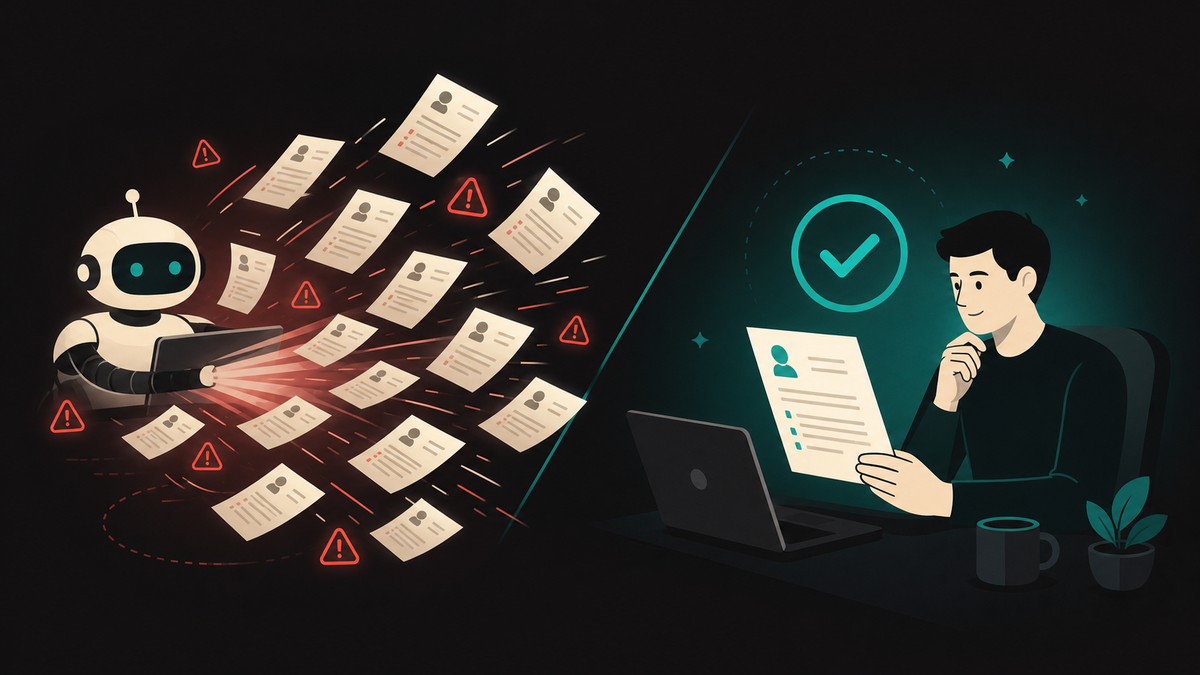
The difference between safe and risky AI applying is not the tool; it is whether a human stays in the loop. Picture a control panel: AI doing the repetitive drafting on one side, you approving every submission on the other.
Does mass-applying even work? The receipts
Set the bans aside: does the volume even pay off? The most-cited real experiment is sobering. One job seeker let AI apply to 819 jobs and got 71 responses (an 8.6% rate) and 5 interviews, roughly one interview per 200 applications. He still valued it for his sanity, since he felt less guilty and took rejections less personally, but as a conversion engine the math is brutal.
Worse, many tools do not even do the one job they advertise. FastApply's May 2026 testing found that of 8 auto-apply bots, only 3 actually clicked Submit; the rest just autofilled forms you would still have to finish. Meanwhile one engineer reportedly fired off 2,843 applications in a few days, the exact velocity that guarantees a flag. High volume, low yield, high risk: that is the autopilot bargain.
An auto-filled application that you never click Submit on is functionally equivalent to no application at all.
— Ekekenta Clinton, Founder of FastApply
Watch: how job seekers are actually using AI apply bots
Workology unpacks how candidates are using auto-apply tools in 2026 and where they help versus hurt, a grounded look at the trend behind this guide.
The safe play: keep a human on the submit button
The compliant, effective middle path is to let AI do the labor and keep yourself the decision-maker. Ulbrich's framing, that you let AI handle the repetitive, text-heavy work while you make every important decision, is the whole rule, with one golden test: never submit text you could not confidently defend in an interview.
Concretely: tailor each application to the specific posting instead of blasting one generic version; review and edit every submission before it goes out; keep your daily count well under platform limits and apply at a human pace; never let a tool auto-submit without your sign-off; and never combine applying with profile scraping. Used that way, as a drafting and tailoring assistant inside a sane automation workflow, AI is both safe and genuinely helpful. The risk lives entirely in the autopilot.
Never submit text that you could not confidently defend in an interview.
— Jürgen Ulbrich, CEO and co-founder of Sprad
Where Pearable fits
Pearable is deliberately the assistant, not the cannon. It tailors each application to the role and keeps you in review mode, so your submissions read as considered and human, the opposite of the duplicate, machine-velocity pattern recruiters flag. Pair that with a centralized tracker, and you get the speed of automation without the behavior that gets accounts restricted.
If you understand how recruiters use AI on the other side of the pipeline, the safe strategy becomes obvious: be the candidate the filters are built to keep, not the one they are built to catch.
Frequently Asked Questions
Can LinkedIn ban or restrict you for using an auto-apply bot?
Yes. LinkedIn detects machine-speed applying as automated inauthentic activities and can throttle or temporarily lock your Easy Apply access; one user was locked out for 30 minutes just for applying very fast manually. Permanent restrictions are most likely when high-volume applying is combined with scraping profile data. Bots moving at machine velocity trip these detectors far more easily than a human would.
How many jobs can you safely apply to per day on LinkedIn?
LinkedIn doesn't publish an official number, but users consistently hit a cap around 50 Easy Apply submissions per rolling 24-hour period, and Premium does not raise it. Hitting the soft cap usually carries no penalty; the counter just resets. To stay safe from velocity flags, stay well under it and spread applications across the day at a human pace.
Can recruiters or an ATS tell if an application was submitted by AI?
Often, yes. The tells are duplicate or near-duplicate answers, a generic buzzword-heavy resume that doesn't mention the actual role, mismatched seniority (such as a junior CV sent to director jobs), and machine velocity like multiple applications to the same job within minutes. Recruiters report systems flagging these as spam; one saw eight applications from the same candidate in two minutes.
What is the AI doom loop in hiring?
It's the self-reinforcing cycle where job seekers mass-apply using AI while employers screen with AI, so the signals that once distinguished candidates collapse. Greenhouse's CEO coined the phrase, and research shows 67% of U.S. candidates now use AI in the job hunt while LinkedIn processes over 11,000 applications per minute. The result is high-volume, low-signal pipelines where keyword matching becomes meaningless.
Does mass-applying with AI actually get you more interviews?
Usually not at the rate the volume suggests. One widely cited experiment of 819 AI-submitted applications produced just 71 responses (8.6%) and 5 interviews, roughly one interview per 200 applications. Many tools don't even submit: testing found only 3 of 8 bots actually click Submit, with the rest just autofilling forms.
What's the safe way to use AI when applying for jobs?
Keep a human in the loop: let AI handle the repetitive drafting and per-posting tailoring, but review and approve every application before it's submitted. Follow the rule of never submitting text you couldn't confidently defend in an interview, stay under platform rate limits, apply at a human pace, and never combine applying with profile scraping. Used as an assistant rather than an unsupervised cannon, AI is both compliant and genuinely helpful.
Automate the busywork, not your judgment
Pearable tailors every application to the posting and keeps you in control of what gets sent, the human-in-the-loop way to move fast without getting flagged.
Get Started Free