
You apply, and within a day your phone buzzes with a link. No recruiter, no small talk, just a webcam, a countdown timer, and a question on the screen. Welcome to the AI interview, the round that now stands between most applicants and a human conversation.
As of 2026, 63% of job seekers say they have been interviewed by AI, up 13 points in just six months. The format feels cold and unknowable, which is exactly why so many people freeze. But here is the reframe that changes everything: an AI interview is a test with a scoring rubric, and rubrics can be studied.
This guide breaks down the three kinds of AI interview you will actually face, what the software is really grading, and the small, concrete moves that shift your score. If you have already worked through our AI interview prep questions, think of this as the layer underneath: the mechanics of the machine doing the grading.
Meet the three kinds of AI interview
AI interview is a catch-all term, and the prep changes depending on which one lands in your inbox. There are three:
- The one-way (asynchronous) video interview: You record yourself answering preset questions, often with a prep timer and a limited number of takes. No human is on the other end; the platform transcribes and scores your responses later.
- The AI phone or voice screen: A conversational voice agent calls you, asks qualifying questions, and follows up on your answers in real time. Calls typically run 5 to 15 minutes.
- The AI-assisted live video interview: A live or recorded video where the system also scores delivery signals such as eye contact, posture, expression, and tone alongside what you say.
What the AI is actually scoring
That line from a 2026 Huzzle interview guide is the whole game. Rapport, charm, and nervous small talk, the things that rescue a shaky human interview, do nothing here. The system grades a narrow, knowable set of signals:
- Transcript keywords: the terms and concepts from the job description, surfaced naturally in your spoken answers.
- Answer structure: whether your response has a clear shape (situation, action, result) instead of wandering.
- Directness: whether you actually answered the question that was asked.
- Pace and filler: speaking speed, long silences, and how dense your ums and uhs get.
- In video, delivery: gaze, posture, and expression as proxies for engagement and confidence.
AI evaluates what you say and how you say it. Nothing else.
— Huzzle, AI interview preparation guide
Where to look: the camera-lens trick
In a video interview your instinct is to watch the other person, or yourself, on the screen. Do not. Look into the small camera lens, usually a dot at the top of your monitor. To the system, lens-gaze reads as eye contact; screen-gaze reads as looking away.
The guidance from 2026 body-language research is specific: aim to spend 60 to 70% of the interview making eye contact with the lens, hold it in natural three-to-five-second stretches rather than a glassy stare, put your camera at eye level, and drag the interviewer's window up near the lens so glancing at it barely breaks your gaze. A sticky note with an arrow next to the camera is a low-tech classic for a reason.
Looking at the camera creates the feeling of eye contact with the viewer, which makes you come across as more direct, confident, and engaged.
— Sean Griffith, Founder of Truffle
Answer like the AI is timing you
Length is where good candidates quietly lose points. On AI phone screens, long, rambling answers that circle back to the question actually score lower than shorter, focused ones. As Truffle's guide puts it, a sharp 60-second answer is often better than a wandering three-minute one.
So lead with the answer. State your point in the first sentence, support it with one specific example, then stop. If you are not sure where to go, a few seconds of silence to think beats an answer that misses the question, because the AI is scoring relevance, and an off-target ramble is worse than a short pause.
The AI is not just recording your words. It is analyzing how you communicate, how directly you answer the question, and whether your experience aligns with what the employer needs.
— Mike Simpson & Jeff Gillis, The Interview Guys
The cheat sheet: what each AI interview scores
Here is the whole landscape on one screen: the format, what the software is grading, and the move that actually shifts your score.
| Interview type | What the AI actually scores | How to prepare |
|---|---|---|
| One-way / async self-recorded video | Transcript keywords matched to the job description, answer structure, pace, and filler words; some platforms flag AI-generated-sounding responses | Look into the camera lens (not the screen) so it reads as eye contact; keep answers tight; clean background, front lighting, tested mic |
| AI phone / voice screen | How directly you answer, whether your experience aligns with the role, pacing, and whether your answer addresses the question | Answer the question directly first; avoid rambling that circles back; a few seconds of silence beats an off-target answer; calls run about 5 to 15 minutes |
| AI-assisted live video | Eye contact (aim 60 to 70% of the time), darting eyes, posture, expression, and vocal tone as proxies for engagement | Camera at eye level; move the interviewer window near the lens; sit upright; hold gaze 3 to 5 seconds at a time, not a fixed stare |
| Cheating-detection layer (all formats) | Behavioral signals like flatline response timing (the same 4 to 5 second delay regardless of difficulty), not just tab-switching | Skip invisible-overlay tools; do real prep instead, since genuine, varied timing and demonstrated knowledge are the safe play |
Anatomy of a high-scoring AI interview
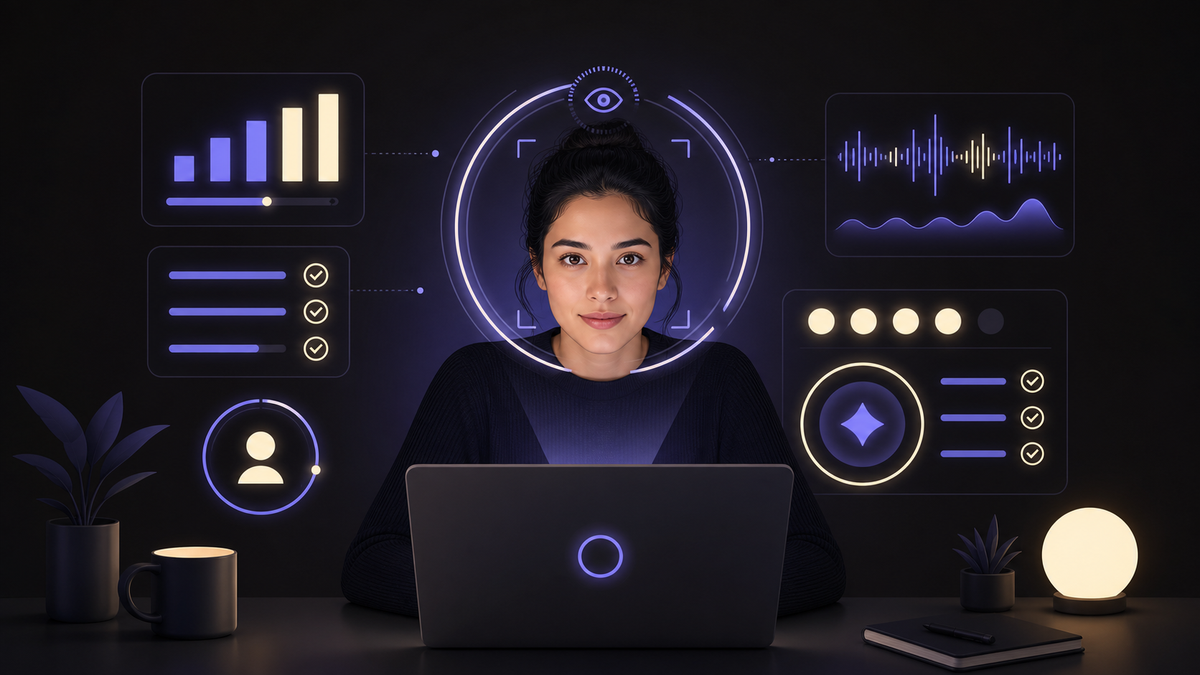
Picture the setup the system rewards: camera at eye level, your gaze on the lens, a clean front-lit frame, and a tight, structured answer landing inside the timer.
The cheating-detection arms race (and why honesty wins)
A whole category of invisible overlay tools now promises to feed you live answers. It is tempting, and it is a trap. By late 2025, about 35% of candidates showed signs of cheating, more than double six months earlier, and detection moved to keep up.
The giveaway is no longer tab-switching; it is behavior. Fabric reports that cheated interviews show flatline timing, where every response arrives after the same four-to-five-second delay regardless of how hard the question is. Real people speed up on easy questions and slow down on hard ones; someone reading off a screen does not. Add the trajectory, with Gartner projecting 1 in 4 candidate profiles will be entirely fake by 2028, and employers are investing heavily in catching exactly this. Genuine prep is simply the lower-variance bet.
Interview cheating has transformed from a fringe behavior into a mature software industry.
— Abhishek Vijayvergiya, Fabric
Can you just refuse an AI interview?
You have more leverage than the format implies. In a 2026 Greenhouse survey, 38% of U.S. candidates withdrew from hiring processes that used AI interviews. The friction is often the secrecy: 70% said they were never told ahead of time that AI would evaluate them, 1 in 5 only found out once the interview had started, and 57% think AI disclosure should be legally required.
Refusing outright may cost you that specific role, so weigh it per opportunity. A measured middle path: ask the employer what the AI measures and whether a human alternative exists. A company that will not say, or that hides the AI entirely, is giving you real data about how it treats people, the same kind of signal our company-culture red-flag guide tells you to watch for.
Candidates are telling us exactly what they want, and it isn't complicated: tell them when AI is in the room and what it's measuring.
— Sharawn Tipton, Chief People Officer at Greenhouse
Watch: a recruiter breaks down the one-way interview
Career coach Madeline Mann walks through what actually happens inside a HireVue-style one-way interview and how to prepare, a useful companion to the mechanics above.
Where Pearable fits
Pearable is built for the stage right before the AI interview: turning a real job posting into a tailored application that actually earns the screen. The same per-posting thinking carries into prep, because the keywords and themes you tuned your application around are exactly what the interview AI is listening for.
From there, the human work is yours: practicing tight, structured answers, following up well, and recovering gracefully when a round goes sideways. Understanding how recruiters use AI end to end just makes every one of those moves sharper.
Frequently Asked Questions
Where should you look during an AI video interview?
Look directly into the camera lens, not at the interviewer's window or your own image on the screen. Looking at the lens reads to the system (and any human reviewer) as eye contact, making you come across as more direct and engaged. A common trick is to place a sticky note with an arrow next to the lens and to position your camera at eye level so it feels natural.
What does the AI actually score in an interview?
AI evaluates what you say and how you say it. In practice that means your transcript scanned for terminology tied to the job description, how directly you answer, your answer structure, your speaking pace, and filler words. In video formats, gaze, posture, facial expression, and vocal tone are also measured as proxies for engagement and confidence.
How long should your answers be in an AI interview?
Keep them focused. On AI phone screens, long rambling answers that circle back to the question score lower than shorter, focused responses, and a sharp 60-second answer is often better than a wandering three-minute one. Answer the question directly first; a few seconds of silence is far better than an answer that misses the question entirely.
Can AI detect if you cheat in an interview?
Increasingly, yes, but not the way many candidates assume. Invisible-overlay tools don't trigger tab-switch alerts, so detection has shifted to behavioral signals like flatline timing, where every answer arrives after the same 4 to 5 second delay regardless of difficulty. One vendor, Fabric, says it detects cheating in most cases, and roughly 35% of candidates showed signs of cheating in late 2025.
Can you refuse or walk away from an AI interview?
Many candidates already do; 38% of U.S. candidates withdrew from hiring processes that used AI interviews, per a Greenhouse survey. You can ask the employer what the AI is measuring and whether a human alternative is available, and 57% of candidates believe AI disclosure should be legally mandated. Disclosure norms are tightening, but a refusal may still cost you that specific opportunity.
How common are AI interviews in 2026?
Very common and growing fast. As of 2026, 63% of job seekers say they have been interviewed by AI, up 13 percentage points in six months. By Q2 2026, an estimated 80% of high-volume recruiting is expected to begin with AI-powered voice screening, so most applicants to large employers will encounter some form of AI screen.
Earn the interview first
Pearable helps you tailor each application to the posting so you reach the interview stage more often, then walk in knowing exactly what the AI is listening for.
Try Pearable Free